
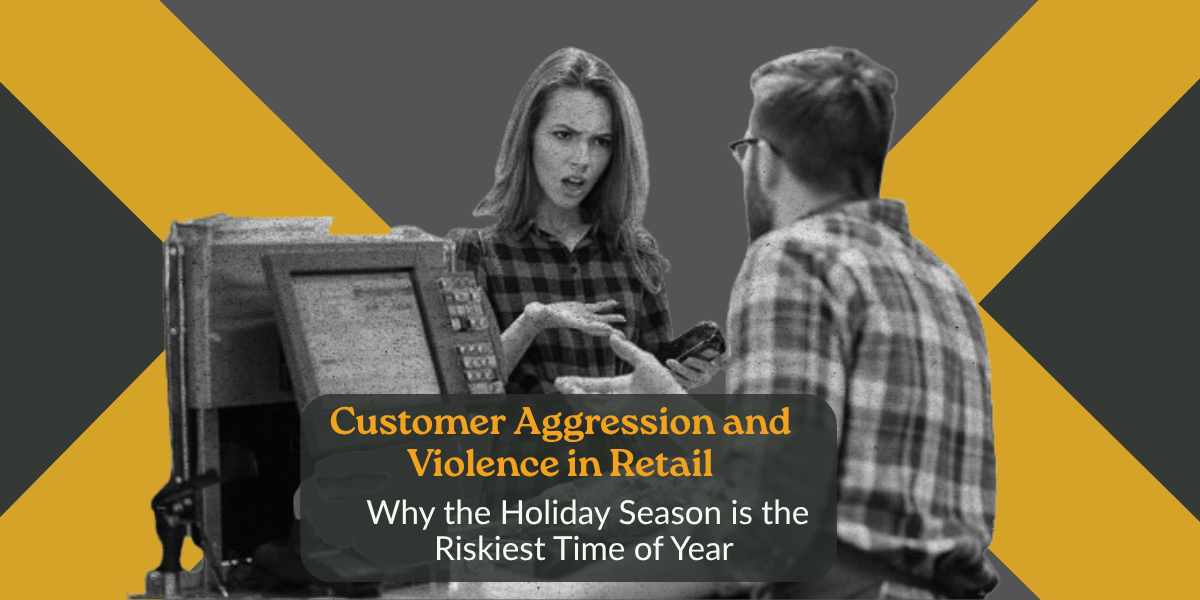


Customer aggression against retail workers has gone from occasional to routine. Peak trading season makes it worse, stacking more inexperienced staff, longer queues and more pressure on the till all at once. That makes it a retention, legal, and wellbeing problem.
Get fresh H&S insights weekly
Retail work comes with a risk that didn't used to be part of the job description.
The British Safety Council put it well: customer aggression used to be a seasonal occurrence, something that flared up around Christmas and other public holidays and then eased off. Since the pandemic, it hasn't. It's just kept climbing, and peak trading season, from Black Friday through to Christmas, is where all of that pressure hits hardest.
In New South Wales, a 2024 survey of 4,600 retail and fast-food workers found 76% had faced regular verbal abuse in the past year. The union representing them puts the real figure closer to 88% once every form of abuse is counted — including the 12.5% who reported physical violence, up 50% from a survey conducted just two years earlier.
These aren't outlier numbers. Ask retail workers almost anywhere in the world and you'll get a similar answer. This is the shape of the job now, and it gets sharper every year between Black Friday and Christmas.
What is customer aggression and violence in retail?
SafeWork SA defines work-related violence as any incident where someone is abused, threatened or assaulted in circumstances connected to their job. That covers a lot of ground:
- Biting, spitting, pushing, grabbing
- Verbal threats and intimidation
- Armed robbery and sexual assault at the extreme end
But day to day, it's usually quieter than that list suggests. At one of Australia's largest retailers, health and safety leadership describes what most shifts actually look like: eye rolls, huffing, folded arms, a passive-aggressive comment here and there. None of that gets logged as an incident on its own, but staff feel the weight of it building over the course of a shift.
Most incident reporting only captures the serious end of that spectrum. Everyday incivility rarely gets recorded at all, which makes it hard to see a pattern building before it turns into something worse.
Why retail carries so much exposure, and why peak season makes it worse
Retail was always going to be exposed to this kind of risk. A few reasons why:
- Cash handling and public-facing roles, every shift
- High staff turnover
- A workforce that skews young, often in their first job
- No real way to screen who walks through the door
This is part of a wider pattern across frontline roles, where the people closest to the risk often have the least support and the least say in how it's managed.
Peak trading season turns up the volume on risks that are already there year-round. Black Friday kicks off the surge, and it doesn't let up until Christmas trading winds down.
WorkSafe Victoria has been flagging this for years: stores hire a wave of casual staff for November and December, right as shops get busier and customers get more stressed. The result is that the newest, least experienced staff end up handling the toughest customers of the year.
That collision is exactly why regulators have been running inspection campaigns around this period for years.
The scale of the problem
UNI Global Union's review of retail violence across more than 20 countries found abuse against shop workers has surged since the pandemic, with the same pattern showing up everywhere from Japan to Finland to Nigeria. Research in the US backs this up: 35% of retail workers now feel unsafe at work, and reports of physical assault are up 22% year on year.
The same pattern holds closer to home:
Australia
The Australian Retail Council's national data found violence, intimidation, threats or abuse featured in roughly one in four retail crime events last year, with weapon-involved incidents up 66% year on year and violent or serious events up 30%. A small group of repeat offenders drives most of it: just 10% of offenders are responsible for more than 60% of all retail crime nationally.
ShopCare's research found 53% of frontline retail workers had faced threatening, abusive or unruly customer behaviour. National crime data shows the same direction of travel: weapon-involved incidents up 10% year on year, serious events up 11%, and threatening events up 14%.
United Kingdom
The British Retail Consortium's 2026 Crime Report recorded 1,600 incidents of violence and abuse against shopworkers every day. That's actually a fall on the year before, but it's still roughly 3.5 times the pre-pandemic rate: in 2020, the same survey recorded 400 incidents a day. The BSC separately found that 40% of retail workers have thought about leaving the sector because of rising abuse and violence.
Want to see how retail safety leaders are responding to these numbers? Watch Behind the Counter: Rethinking Safety Amid Retail Violence, our webinar digging into what's driving the shift on the ground.
What customer aggression and violence is costing retailers
Employee wellbeing takes an enormous toll, and so does retention. Research in the US found 52% of retail workers say they're likely to leave their job within 12 months over safety concerns. Among those who've actually experienced violence, that jumps to 53%. Nearly half of store managers now say safety concerns are making it harder to hire, up sharply from the year before.
That retention risk collides with the workforce-inexperience problem peak season already creates:
- New hires are the most likely to be injured on the job
- New hires are also now among the most likely to walk if the role turns out riskier than expected
- Retail already has to rehire and retrain a large share of its frontline every year
Put those three together and you've got a costly loop that's hard to break without addressing the safety piece directly.
The psychological toll of customer aggression
Repeated exposure to incivility and aggression is a psychosocial hazard, not just a physical one. In Australia, 17.1% of retail workers report an ongoing mental health condition, a figure researchers flag alongside the sector's daily exposure to customer aggression as part of the same picture.
Young workers, often in their first job, don't always have the life experience to put aggressive behaviour into context. That makes the cumulative effect harder to absorb.
Unaddressed psychological trauma from customer aggression is also a known driver of burnout, absenteeism and higher turnover, the same forces behind the retention numbers above. One useful reframe: how much of that trauma staff carry is often shaped by design, not just behaviour, meaning store layout and unclear policy can leave staff more exposed, regardless of who's causing the incident.
What the law now requires
Australia
In NSW, assaulting, stalking or intimidating a retail worker can mean up to four years in prison, even without physical harm, rising to eleven years for wounding or grievous bodily harm.
Nationally, retail sits alongside other high-exposure sectors under the model WHS Regulations' psychosocial hazard duties, so employers have to identify hazards like customer aggression, assess the risk, and put controls in place. Of the three markets, Australia has gone furthest on formal psychosocial regulation.
New Zealand
The Health and Safety at Work Act 2015 puts a broad duty on PCBUs to manage risks to health, including psychological health, as far as reasonably practicable, without Australia's level of prescriptive detail.
The country's first dedicated national survey on customer aggression, run with ShopCare and KPMG, is due to publish in late 2026, and it should give a fuller picture than the regional data available so far.
United Kingdom
The Crime and Policing Act 2026 created a standalone criminal offence of assaulting a retail worker, something the BRC had pushed for since the pandemic. From October 2026, employers also have to take all reasonable steps to prevent customers from harassing staff.
The UK has moved furthest on criminal law of the three markets, but its psychosocial hazard framework is still thin: employers are largely working from HSE's general guidance on stress and mental health at work rather than anything retail-specific.
Across all three, one thing holds true: a zero-tolerance poster on the wall doesn't count as a control measure anymore. Regulators want hazards identified, risks assessed, and controls documented, the same rigour already expected for physical safety.
A short guide: what to do when customer aggression escalates
Most incidents start at one of a handful of predictable moments, not out of nowhere.
Knowing where they usually start is most of the battle:
- Challenging suspected shoplifting. The single biggest trigger, cited in 60% of incidents logged by Usdaw.
- Enforcing age-restricted sales. 65% of shop workers report abuse tied directly to asking for ID. The Association of Convenience Stores calls it one of the top three triggers in convenience retail.
- Customers under the influence. Alcohol or drugs add friction to every other trigger on this list.
- Queue and wait-time frustration. 68.5% of retail workers now deal with angry customers regularly, and long wait times are the top cited cause.
- Self-checkout friction. Harvard's Shift Project found workers are 14% more likely to be treated disrespectfully in stores using self-checkout, largely because the technology tends to arrive alongside staffing cuts rather than instead of them.
After identifying these triggers, three actions matter most:
1. Prevent. Good sightlines, enough staff during known high-risk hours, clear signage, and an escalation process staff actually know exists.
2. Respond. Calm, controlled communication. A clear point to disengage. Clarity on when to call the police rather than handle it alone.
3. Support. A check-in straight after any incident, for anyone who witnessed it too, not just the person directly involved. Access to an EAP and paid recovery time where it's needed.
What good practice against customer violence looks like
The retailers handling this well tend to share a few habits:
- Fast, simple reporting that captures everyday incivility as well as serious incidents, so patterns show up before they escalate
- Leading indicators tracked alongside the lagging ones: EAP usage, absence patterns, training completion, not just injury counts
- Regular, structured conversations with frontline staff, not an annual survey but an ongoing habit
- De-escalation training paired with environmental design, rather than one instead of the other
- Fast, trackable onboarding for the seasonal surge, so new hires aren't learning the job and managing conflict at the same time
- Clear messaging from leadership that staff safety comes before protecting stock
Where health and safety software fits in
The habits above only work if the system behind them is fast enough to use at the moment.
ecoPortal's point-of-sale integration lets staff log an incident with a click, right from the till system they already use, rather than filling out paperwork later when the moment's passed. The same visibility helps leaders catch a problem store before it shows up in injury stats, and gets seasonal hires through induction before their first shift instead of week two.
Final Words
Peak season didn't create this problem, it just makes eight weeks a year impossible to ignore, right when the workforce is newest and the stores are busiest.
The retailers getting ahead of it aren't waiting for peak season to arrive before they act. They're building the reporting, the induction and the support systems now, so the surge doesn't catch their people off guard.
ecoPortal helps retail organisations across Australia, New Zealand and the UK bring incident reporting, safety induction and wellbeing support into one system, so frontline teams are protected before peak season hits, not after.
Want to see how this works in action? Book a chat with our team.
Key Takeaways
- Customer aggression in retail is routine now, not occasional. Across the UK, Australia, New Zealand and the US, more than half of frontline workers report regular abuse.
- Peak season doesn't create new risks. It stacks the ones already there. Inexperienced staff, longer queues and more pressure all peak at the same time.
- It's a retention risk as much as a safety one. Over half of US retail workers who've experienced violence say they're likely to leave within a year.
- Regulation is tightening across all three regions. From the UK's new assault offence to Australia's psychosocial hazard duties, a zero-tolerance sign on the wall isn't enough anymore.
.png?width=352&name=Playbook%20The%20Coaches%20Guide%20to%20Driving%20Real%20Change%20in%20Safety%20(1).png)
.png?width=352&name=SS6%20Designing%20for%20Error%20(1).png)
.png?width=352&name=How%20to%20De-escalate%20an%20Aggressive%20Customer%20(1).png)
.png?width=352&name=Workplace%20Fatalities%20Understanding%20the%20Family%20Impact%20and%20Communicating%20Better%20(1).png)
