
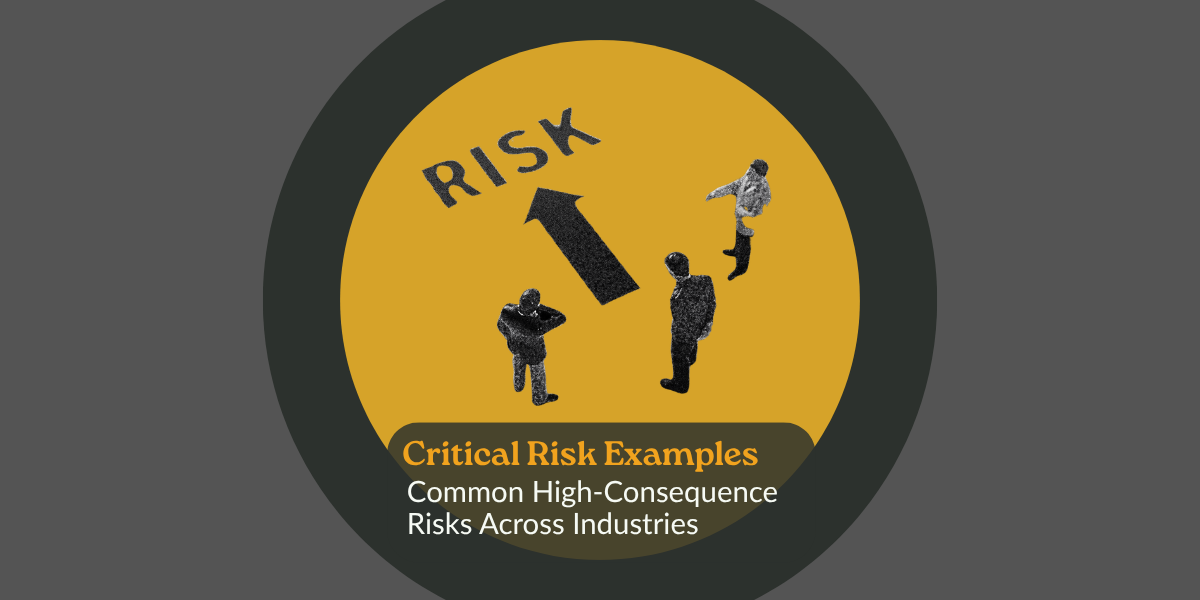


Critical risks are the workplace exposures with the potential for the most severe outcomes, not the most frequent ones. They span every industry, from machinery entanglement on a manufacturing floor to psychosocial risk in banking and finance.
This article breaks down common critical risk examples across five industries, and what it takes to keep the controls on them actually working.
Get fresh H&S insights weekly
The International Labour Organization estimates that workplace accidents and diseases kill 2.78 million people worldwide every year, alongside 340 million non-fatal injuries.
That figure splits into two very different categories. Roughly 2.4 million deaths, or 86%, build up over years of exposure to occupational disease, such as cancers, respiratory and circulatory diseases and musculoskeletal disorders.
The remaining 380,000, or 14%, come from workplace accidents: single events with an immediate outcome such as falls, being struck by objects, transport incidents and machinery failures.
Critical risk, the focus of this article, sits on that acute side of the split. A wet floor near miss might happen weekly; a lockout/tagout failure might happen once a decade, and take a life when it does. Treating both the same way is how critical risks slip down the priority list.
This looks different depending on the industry. Here, we explore examples across five: manufacturing, government, retail, transport and logistics, and banking and finance.
What are critical risks?
Critical risk refers to any risk with the potential to cause serious injury, fatality, significant environmental harm, or major operational disruption if controls fail or are absent. This aligns closely with how many regulators and safety bodies define high potential or serious injury and fatality (SIF) risks, events capable of causing life-altering harm or catastrophic outcomes.
Critical risks have traditionally sat with construction, manufacturing, mining and logistics. The scope has widened over the past few decades, and most sectors now carry their own version of high-consequence exposure.
What connects all of it is consequence, not frequency. An organisation can go years without a serious incident while exposure to critical risks stays present in day-to-day operations, and that stretch of quiet can build a false sense of control around risks that have simply become routine.
For a deeper look at what critical risk covers and why organisations are prioritising it, see our full guide, What Is Critical Risk?
How to identify whether a risk is critical
A practical test: could this plausibly result in death or permanent injury if the control failed? If yes, it belongs on the critical risk list, no matter how rarely it comes up. This sits at the core of fatal risk management: isolating the small number of exposures that could kill or permanently injure someone from the much larger volume of routine hazards.
Identifying these risks draws on more than one source. Useful inputs include:
- Incident history and near misses, which flag where control failures have already come close to serious outcomes.
- Frontline feedback, often the first place a gap between documented control and real practice shows up.
- Formal risk assessments, applied specifically to high-consequence activities rather than general hazards.
- Audit findings, testing whether controls hold up under scrutiny, not just on paper.
- Regulator guidance, from WorkSafe and equivalent bodies, on what's already been identified as high potential elsewhere.
Critical risk status shouldn't stay fixed at the point the register was first built. It needs reassessing whenever tasks, locations, contractors, assets or operations change.
Common examples of critical risks in the workplace
Some risks show up everywhere: manual handling, contractor and visitor safety, hazardous substances exposure. Others concentrate heavily in specific industries, shaped by the work itself. Machinery entanglement is almost exclusive to manufacturing floors. Lone working risk looks different in a government field role than it does in an after-hours retail shift.
Below, we've broken down the most common critical risk examples by industry.
Manufacturing
- Machinery entanglement and equipment guarding failures. Contact with running equipment was the leading cause of manufacturing fatalities in the US in 2024, out of 355 recorded deaths that year.
- Energy isolation failures. Skipped or bypassed lockout/tagout steps during maintenance remain one of the most common triggers of serious injury on a production floor.
- Confined space entry. Tanks, silos and enclosed processing units carry atmospheric and entrapment hazards that demand permit systems and rescue planning, not PPE alone.
- Hazardous substances and chemical exposure. Solvents, coatings, dusts and process chemicals require controlled handling, storage and exposure monitoring to prevent both acute injury and long-term harm.
- Fire, explosion or uncontrolled energy release. Combustible dust, flammable materials and high-pressure systems turn a contained process fault into a site-wide incident.
Manufacturing alone accounted for 10.1% of serious workers' compensation claims in Australia in 2024, among the highest of any sector.
Government
- Compliance and regulatory risk. Public sector bodies operate under heightened scrutiny and statutory duty of care obligations, where a control failure carries legal and reputational consequences on top of the immediate safety impact.
- Violence and aggression toward frontline staff. A persistent risk for public-facing roles like council inspectors, compliance officers and social workers. Government workers overall experience workplace violence at roughly three times the private-sector rate. In the UK, council workers face thousands of assault incidents a year, with 88% of councillors reporting repeated abuse.
- Contractor and visitor safety. Councils and public bodies routinely oversee external contractors on roading, maintenance and construction work, extending risk exposure beyond direct employees.
- Lone working in the field. Inspectors, social workers and outdoor field staff routinely operate without direct supervision, which extends response time when something goes wrong.
Retail
- Violence and abuse from the public, including weapon-related incidents and armed robbery risk in cash-handling roles. UK retail workers now face over 2,000 incidents of violence or abuse a day, the highest rate on record and up more than 50% year on year, with 70 incidents a day involving a weapon.
- Manual handling and repetitive strain. Stocking, till work and repeated lifting drive a high volume of serious claims, often overshadowed by the more visible risk of violence.
- Lone working during opening, closing and night shifts, the exact windows when staffing is thinnest and cash exposure is highest.
Transport & Logistics
- Vehicle and mobile plant interactions. Being struck by a moving vehicle causes 37% of fatal accidents in the UK transport and storage sector, most often from inadequate separation between pedestrians and forklifts, HGVs or pallet trucks. Workers in transport and storage overall are around three times more likely to be killed at work than the national average.
- Lifting operations and dropped objects. Pallet racking, forklift loads and manual lifting in warehouse environments carry ongoing risk of dropped loads and crush injuries.
- Fatigue and shift-related impairment, particularly on night shifts and long-haul routes, where reduced alertness compounds every other risk on this list.
Banking & Finance
- Robbery and armed hold-up exposure, concentrated in branch and cash-handling roles. A study of bank robbery survivors found 14.5% suffered probable acute stress disorder, with post-traumatic stress documented as a longer-term outcome.
- Psychosocial risk and burnout, driven by sales targets, compliance pressure and customer conflict. 17% of UK finance and insurance employees report burnout, against a 12% average across other sectors.
- Cash handling risk, which carries a physical threat and a sustained psychological load for the staff who handle it daily, whether or not an incident ever occurs.
How to match critical risks with controls
Each critical risk needs a specific control designed to prevent the event or reduce its consequence. There's no universal control that fits every exposure; the right response depends on what's actually driving the risk.
Common categories of critical controls include:
- Engineering controls, such as machine guarding or physical barriers between people and moving plants.
- Isolation procedures, covering energy sources, hazardous substances or restricted zones.
- Permits, required before high-risk work like confined space entry or hot work begins.
- Competency checks, confirming the people carrying out high-risk tasks are trained and current.
- Scheduled inspections, verifying equipment and controls are still fit for purpose.
- Emergency protocols, covering what happens if a control fails and someone is exposed.
- Contractor requirements, extending the same control standards to anyone working on site who isn't a direct employee.
Engineering controls, isolation and permit systems have long been standard on a manufacturing floor. That same discipline now applies just as directly to a retail loading dock or a bank branch: name the control, assign an owner, check it on schedule.
A control only holds real value once it meets all three. A lockout/tagout procedure that exists in a policy document but is never verified on the floor, or a lone worker policy with no working check-in system behind it, both look like controls on paper. Neither protects anyone in practice.
Fatal risk management is built on avoiding that gap, keeping a small number of high-consequence risks under continuous, verified control rather than being reviewed once and left alone.
Explore our Critical Control Management Guide and get the full picture.
How software supports critical risk controls visibility
Verification at scale is where most of this breaks down. A handful of critical risks across one site is manageable with a spreadsheet and good intentions. Multiply that across dozens of sites, contractors and shifts, and the same approach loses track of which controls were checked, when, and by whom.
A safety software closes that distance by giving teams live visibility over critical risks, controls, incidents and corrective actions in one place. A few capabilities do most of the work:
- Live risk registers, keeping high consequence risks visible rather than buried in a document nobody opens between audits.
- Control libraries, so the same critical control isn't reinvented site by site.
- Scheduled audit and inspections, turning "checked on a fixed schedule" from a policy line into something that actually happens.
- Mobile reporting, letting frontline teams log what they see from wherever they're standing.
- Incident capture, feeding real events straight back into the risk register instead of sitting in a separate system.
- Corrective action tracking, closing the loop when a control gap is found.
- Dashboards, giving leadership a single view of exposure across sites and teams, rather than a report compiled once a quarter.
ecoPortal brings these together in one platform, helping teams identify, monitor and act on high-consequence risks across different sites and teams. For organisations serious about SIF prevention, that's the practical difference: knowing in real time whether a critical control is holding, not finding out after something's gone wrong.
Final Words
Naming a critical risk is the easy part. The harder, ongoing work is keeping the control on that risk verified, owned and checked, across every location, shift and contractor where the exposure exists.
Most organisations don't lose visibility because the risks are unknown. They lose it because a spreadsheet or a quarterly audit can't keep pace once verification spans multiple teams and functions. ecoPortal gives safety teams a live, connected view of critical risks and their controls, so nothing sits unverified until an incident forces the question.
Talk to our team and learn how ecoPortal fits your critical risk management approach.
Key Takeaways
- Critical risk prioritisation runs on consequence, not frequency. A rare event with fatal potential outranks a frequent one with minor impact.
- Critical risk profiles are industry-specific. What's almost exclusive to a manufacturing floor looks nothing like the exposure in a bank branch or a council field role.
- A control only holds value once it's specific, assigned to an owner and checked on a fixed schedule. Anything less is a control on paper only.
- SIF prevention depends on ongoing monitoring across sites and teams, not a one-off assessment filed away and forgotten.
.png?width=352&name=How%20to%20De-escalate%20an%20Aggressive%20Customer%20(1).png)
.png?width=352&name=Critical%20Control%20Management%20Guide%20(2).png)
.png?width=352&name=Workplace%20Fatalities%20Understanding%20the%20Family%20Impact%20and%20Communicating%20Better%20(1).png)
