



Picture a busy Monday morning at your main facility. Delivery drivers are queuing at the loading bay. A maintenance crew has slipped straight past the front desk without signing in. And the receptionist has just stepped away from the desk, leaving no one to prompt visitors to sign in.
In that moment, you have no way of knowing whether anyone has read the current hazard register, whether their induction is still valid, or whether they are legally permitted to perform their work on your site.
This is the daily tension between maintaining operational speed and actually keeping people safe. When visitor management relies on disconnected systems or simple human habit and familiarity, it is only a matter of time before the process fails.
True site safety requires a process that is as seamless as it is consistent. And that starts with asking an honest question: is your current visitor management system actually working?
Skipped Check-Ins: The Contractor Management Gap That Keeps Coming Back
When we look at feedback from health and safety leaders, a clear picture emerges. The single biggest contractor management challenge safety managers face is people skipping the check-in or check-out process entirely. Not paperwork. Not a system configuration.
Close behind it: verifying that contractors hold the right qualifications, licences, and site inductions before they start work.
Neither of these is a technology problem. They are a process design problem. And the solution is a system that enforces standards without relying on a familiar face or a busy receptionist to make the call.
The Duty of Care: What It Means for Every Visitor on Your Site
Under the Health and Safety at Work Act 2015 (NZ) and the WHS Act 2011 (AU), the duty to ensure health and safety extends to every person on site, contractors, visitors, suppliers, delivery drivers, maintenance crews, and merchandisers, the moment they step through your gate.
This is not a best-practice guideline. It is a legal obligation. If an incident occurs, you must demonstrate that you took reasonable, practical steps to verify who was on-site, whether they were suitably qualified, and that they understand the on-site safety hazards. That obligation doesn’t disappear just because someone’s a contractor and they’re only there for an hour.

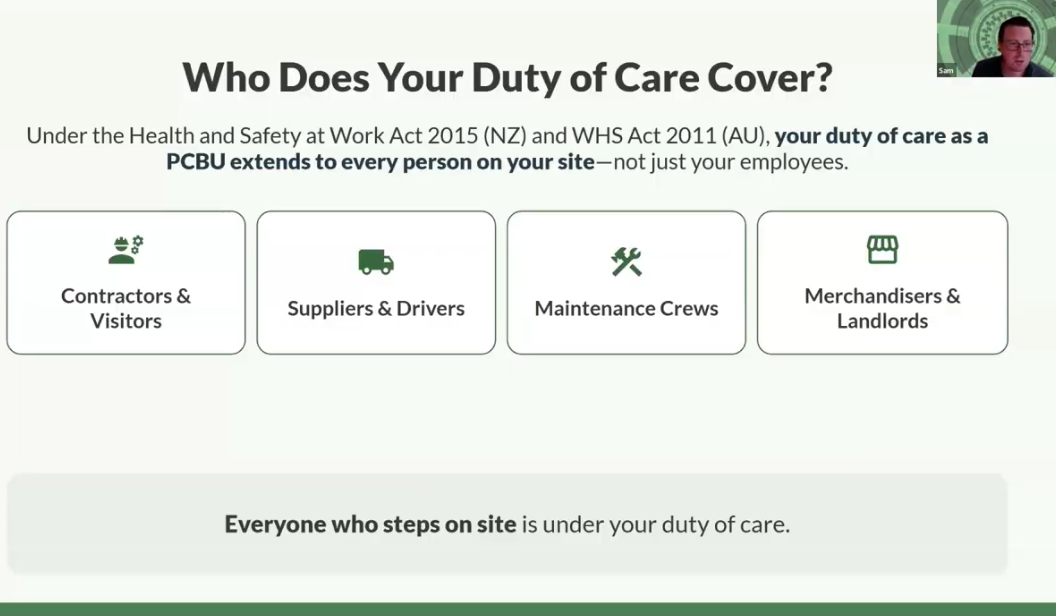
Every person who enters your workplace is your responsibility. Understand what duty of care really means for organisations and why it matters.
Your Complete Audit Trail for Everyone Who Enters Your Sites
It’s tempting to frame visitor management as a contractor compliance exercise, a box to tick before auditors arrive. But the organisations that get real value from their systems see it differently.
An efficient contractor safety management process gives you three things that go well beyond a contractor sign-in sheet:
- Accountability in an emergency: knowing exactly who is on site, at which location, at any given moment.
- Auditability when things go wrong: a complete, timestamped record that demonstrates reasonable steps were taken.
- Operational intelligence: a clear picture of site activity over time, helping you spot trends, address recurring issues, and make better decisions about how access is managed across your locations.
There is also a less-discussed risk worth naming: what happens when a contractor is involved in an incident and you need to restrict their access to your other locations? If your systems are siloed, the answer is: slowly, manually, and inconsistently. A connected system changes that.
See how the full contractor journey, prequalification, induction, sign-in, control of work, and performance monitoring, connects and why that integration matters for your organisation’s risk profile.
Managing the Full Contractor Safety Life Cycle
To truly manage visitor and contractor safety, you need to look beyond simply signing in at the door. Effective visitor management is one stage within a broader, connected life cycle:
-
Prequalification: confirming, before anyone arrives, that the contractor organisation meets your health, safety, and insurance standards.
-
Onboarding: delivering site-specific inductions and confirming they have been completed.
-
Sign-In (this is where visitor management sits): registering arrival, verifying active inductions, and presenting current site hazards.
-
Control of Work: managing on-site activities through risk assessments, JSAs, or project-specific requirements.
-
Performance monitoring: reviewing contractor safety performance post-job to inform future access decisions.
When visitor management is isolated from these other stages, the process breaks down. The contractor who’s been coming to your site for twenty years gets waved through without a check. The new delivery driver’s induction status is unknown. The intern accompanying a familiar contractor has never been set up in the system.
Each of these scenarios is manageable. But only if your visitor types, and the requirements attached to each, are clearly mapped before you configure anything.
What Modern Visitor Management Software Actually Does
The most common failure point in manual visitor management is not malicious, it is human. People are familiar, rushed, or simply uncertain about the rules.
Connected visitor management software replaces individual judgment calls with configurable, automated rules. You define the standards once (which inductions are required, how recently they must have been completed, which contractors require prequalification checks) and the system applies them consistently, at every location, every time.
In practice, this means:
-
A contractor whose induction has lapsed cannot check in until it has been renewed, no exceptions, no workarounds based on familiarity.
-
A visitor type that requires host notification automatically triggers that notification at sign-in.
-
A contractor not in good standing at one site can be flagged across all locations within the same platform.
Geofence check-in via the mobile app adds another layer of practicality for multi-site or project-based organisations. When a contractor opens their app near a registered site, they are prompted to check in directly, reducing friction that leads to skipped sign-ins.
From an administrative perspective, a single standardised process can be applied across every location.
Final Words
Getting contractor safety management right requires a clear understanding of who is coming through your doors, what they need to know before they do, and a system that enforces those standards consistently, without relying on the right person being in the right place at the right time.
The organisations that do this well are not doing it out of obligation alone. They understand that knowing who is on site and why is the foundation of a truly resilient operation..
Key Takeaways
-
Integration is essential: standalone visitor management systems leave critical gaps; connecting sign-ins with inductions, prequalifications, and contractor records ensures standards are applied at every location.
-
Compliance is non-negotiable: under the Health and Safety at Work Act 2015 (NZ) and WHS Act 2011 (AU), managing contractor and visitor safety is a legal duty of care, requiring an auditable record of who was on site and whether they were qualified to be there.
-
Process design drives behaviour: people skip check-ins when processes are burdensome or disconnected; a system that removes friction makes it easier for visitors to do the right thing.
Ready to see what a connected visitor management system looks like for your organisation?

.png?width=352&name=Playbook%20The%20Coaches%20Guide%20to%20Driving%20Real%20Change%20in%20Safety%20(1).png)
.png?width=352&name=SS6%20Designing%20for%20Error%20(1).png)
.png?width=352&name=How%20to%20De-escalate%20an%20Aggressive%20Customer%20(1).png)

.png?width=352&name=Workplace%20Fatalities%20Understanding%20the%20Family%20Impact%20and%20Communicating%20Better%20(1).png)
