
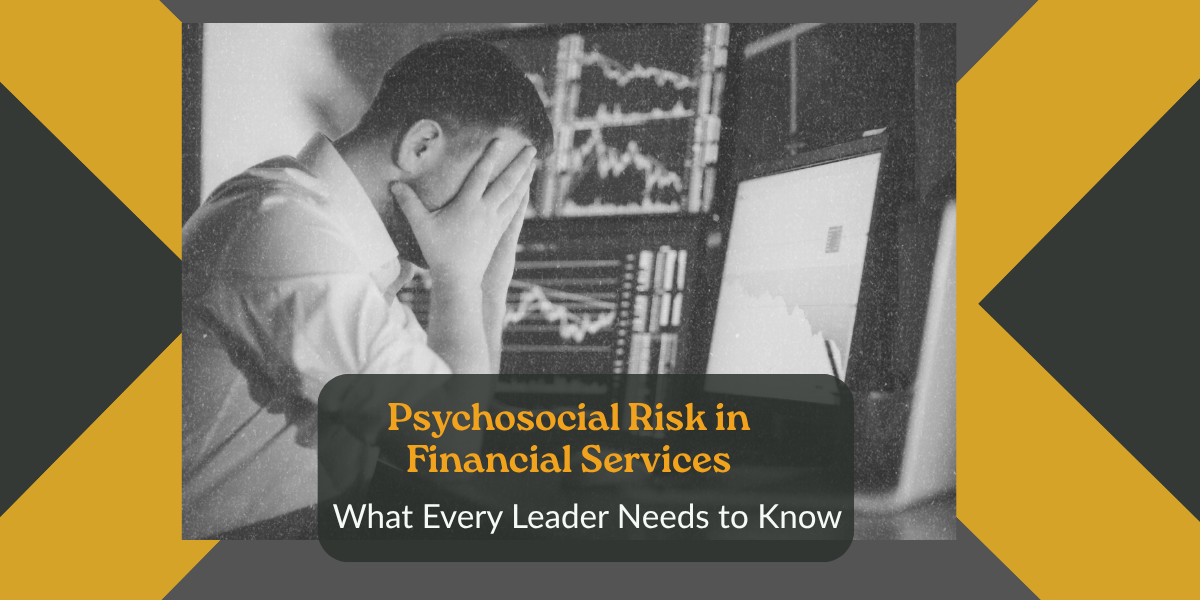


Psychosocial risk is built into how financial services work is designed: high demands, limited control, constant change. It's also one of the costliest categories of workplace injury, and regulators across Australia, New Zealand, and the UK are stepping up enforcement.
Understand why the sector carries so much exposure, what the evidence shows, and how leading organisations are identifying, assessing, and controlling these risks.
Get fresh H&S insights weekly
Mental health claims in financial services cost nearly four times more than physical injuries and take four times longer to recover from.
Financial services have the perfect conditions for psychosocial harm to take root. High demands, limited control, intense performance pressure, constant change aren't occasional features of the work, they're how the work is designed. And regulators across the globe are now actively enforcing obligations that most organisations aren't fully prepared for.
This article covers what psychosocial risk actually means in the finance services context, and how leaders can identify and manage it in practice.
What are psychosocial risks in the workplace?
Safe Work Australia defines psychosocial risks in the workplace as anything at work that may cause psychological harm, including how work is organised, managed, and the behaviours that happen within it. The most common include:
- High work demands with low control over how they're met
- Poor role clarity or conflicting expectations
- Insufficient support from managers or peers
- Effort-reward imbalance, giving significantly more than you receive in recognition or reward
- Workplace bullying, harassment, or interpersonal conflict
- Job insecurity and ongoing organisational change
- Remote work isolation, particularly where peer connection has historically been a buffer against pressure
These hazards are systemic: they come from how an organisation is designed and led, not how well individuals cope. That's why frameworks like ISO 45003 put the responsibility on the organisation, not the person experiencing harm.
Psychosocial risk in financial services: why the sector is especially exposed
The evidence consistently shows that financial services — banking, insurance, wealth management, and related fields — carries a higher concentration of psychosocial risk factors than most other sectors.
The structural drivers
A peer-reviewed review of 20 studies on work-related stress in banking found a consistent pattern: stress levels in banking workplaces have reached critical levels. The documented effects include depression, anxiety, burnout, and psychiatric disorders.
Common contributing factors include:
- Intense performance pressure and demanding sales targets
- Role restructuring from mergers, acquisitions, and digital transformation
- Reduced headcount concentrating workload on those who remain
- Customer-facing roles requiring sustained emotional labour, especially for frontline and branch staff
- Strict procedural compliance that leaves employees with limited control over how they work
- Rapid technology change creating continuous pressure to update skills
- Career stagnation in institutions with flattened structures
A study with 484 banking employees across 26 companies identified the two most stressful psychosocial risk categories in the sector as lack of control over workload and limited career development opportunities. The performance appraisal system itself was flagged as a major stressor, which is worth examining closely if you're responsible for how people are measured and recognised.
A large-scale study of burnout in the Spanish banking sector found branch staff showed significantly higher emotional exhaustion and cynicism than those in central services, driven by daily interpersonal stress and the pressure to sell complex products to customers in financial difficulty. For organisations with significant frontline workforces, this risk is built into the design of the work itself.
What the law now requires of financial services leaders
Regulators across Australia, New Zealand, and the UK are increasing enforcement activity around psychosocial risk, and financial services organisations are a named priority.
In Australia and New Zealand, the Person Conducting a Business or Undertaking (PCBU) is legally responsible for psychosocial risk management. For large financial institutions, that's the organisation itself, and its officers carry personal liability for failures of due diligence.
Under the model WHS Regulations, duty holders are required to:
- Identify reasonably foreseeable psychosocial hazards
- Assess the risks those hazards create
- Implement control measures, with a preference for work design over individual coping strategies
- Consult with workers throughout the process
- Review controls regularly as conditions change
The amended Regulations also require PCBUs to consider how hazards interact. A high-demand role with low support and poor career development creates a very different risk profile than any single factor in isolation. Regulators expect that complexity to be reflected in your risk assessment.
They are no longer satisfied with EAP subscriptions and mental health awareness days as evidence of compliance. The expectation is a systematic, documented approach to hazard identification, risk assessment, and control, the same rigour applied to physical safety.
The cost leaders can't afford to ignore
Mental health conditions are the most expensive category of workplace injury in Australia. The productivity cost of absenteeism from psychological injury is substantially higher than from physical injury, a reflection of longer recovery times and the challenges of returning to work safely. Globally, mental health conditions cost more than US$1 trillion a year in lost productivity, according to the World Health Organization.
In Australia, the cost gap between mental health claims and other workplace injuries is stark. According to Safe Work Australia data, the median compensation paid for a mental health condition claim was AU$58,615, more than three times the AU$15,743 median for all injury and disease claims. Mental health claims also involved far longer recovery: a median of 34.2 working weeks lost, compared with 8.0 weeks for all injuries and diseases combined.
The reputational and ESG dimension
Despite growing awareness, most organisations still don't incorporate psychosocial risks into strategic risk management. The barrier is practical difficulty, not lack of awareness. Enforcement action, high-profile claims, or public disclosures can cause reputational damage that exceeds the direct financial cost.
For listed institutions, social metrics like employee wellbeing and psychological safety are attracting growing scrutiny from investors and proxy advisers. The question for CFOs and governance teams: can your organisation demonstrate this is being managed with rigour?
Our webinar Wellbeing as a Driver of Safety and Organisational Resilience explores what a mature wellbeing strategy looks like and how it connects to safety performance.
How high-performing financial organisations are responding
The organisations that manage psychosocial risk well don't treat it as a problem to fix after the fact. They design it out from the start.
It's the same logic as physical safety: tackle the hazard at its source first, then the way work is designed, and only then individual-level support.
1. Identify
Map psychosocial hazards across your workforce: by role, team, and location. Frontline, branch-based, and customer-facing roles consistently carry higher risk than central services or back-office functions.
Most psychosocial harm goes unreported, so incident data alone won't give you the full picture. A fuller picture comes from:
- Validated psychosocial risk assessment tools
- Structured consultation with workers
- Data from absence patterns, turnover rates, and performance management trends
2. Assess
Evaluate the likelihood and severity of harm from each identified hazard, and how they interact. The banking sector evidence is clear: a high-demand role with low autonomy and poor career development creates a risk profile greater than the sum of its parts. Structured, validated frameworks exist specifically for this kind of analysis, and using one gives your work the rigour regulators expect.
3. Control
Apply controls in order of effectiveness, starting with work design:
- Workload management and role clarity: Addressing high-demand, low-control combinations at source
- Manager capability development: Empowering, supportive leadership is one of the most consistent protective factors identified in the banking sector evidence
- Career development pathways that give staff genuine progression opportunities
- Appraisal systems that reflect real contribution, not just sales outcomes
- Psychological safety, so staff feel able to raise concerns without fear of consequences
- Employee Assistance Programmes as a supplementary layer, alongside the structural controls above
4. Review
Organisational change — restructuring, technology implementation, leadership transitions — creates new hazard profiles. Build review cycles into your WHS management system, consult workers regularly, and use leading indicators to track whether your controls are working.
Australia, New Zealand, and the UK: what's the same, and what's different
For financial institutions operating across ANZ and the UK, psychosocial risk management requires awareness of real regulatory differences in legal framework, enforcement approach, and practical expectations.
Australia: the most prescriptive regulatory environment
Australia has moved furthest of the three regions in codifying psychosocial risk obligations.
Since April 2023, the model WHS Regulations have created specific, enforceable duties. The Commonwealth Code of Practice 2024 sets out what compliance actually looks like in practice. SafeWork NSW has signalled a 25% increase in psychosocial-focused inspector visits, with a named focus on organisations with 200 or more employees.
Key things to have in place:
- A documented psychosocial hazard identification process
- Evidence of worker consultation
- Control measures that go beyond EAP and awareness training
- Regular review cycles
New Zealand: broad duty of care, active regulator
New Zealand's Health and Safety at Work Act 2015 places a broad primary duty of care on PCBUs to manage risks to health — including mental health — so far as is reasonably practicable. The risk for NZ-based leaders comes from investigations following significant incidents, where the absence of a systematic approach will be very difficult to defend.
WorkSafe NZ's Principal Advisor on Mentally Healthy Work joined us in the webinar Designing Workplaces to Support Psychosocial Safety, well worth watching if you're operating in this jurisdiction.
United Kingdom: Management Standards and conduct risk
The HSE's Management Standards framework covers six hazard areas: demands, control, support, relationships, role, and change. UK financial services organisations face a dual exposure: HSE scrutiny and potential conduct risk implications from the FCA's ESG and conduct expectations. Poor employee wellbeing outcomes can become a board-level matter in a way that's distinct from ANZ.
For organisations operating across all three jurisdictions, a single ISO 45003-aligned framework applied consistently — with local regulatory nuances documented — is the most efficient and defensible approach.
What good psychosocial risk management looks like in financial services
The most consistent protective factor across the banking sector evidence is social support from managers, peers, and the organisation itself. Organisations that build genuine support structures into how work is managed show materially better outcomes.
The markers of good practice include:
- Leadership that treats employee psychological health as a strategic priority, with board-level visibility and executive accountability
- Work design that gives employees meaningful control over how they meet their objectives
- Transparent, fair appraisal and reward systems that reflect real contribution
- Psychological safety where staff feel able to raise concerns, report near-misses, and challenge unsafe practices without fear
- Regular, structured worker consultation as part of the risk management process
- Data-driven monitoring using leading indicators: workload distribution, leave patterns, pulse survey results, manager capability assessments
If loneliness or social disconnection are showing up in your workforce data, our session Loneliness: From Public Health Concern to Workplace Risk explores this as an emerging psychosocial hazard, particularly relevant for remote and hybrid financial services workers.
Final Words
Psychosocial risk isn't a future problem. It's already showing up in claims data, regulatory activity, and the day-to-day experience of people working in financial services. The organisations that get ahead of it aren't waiting for an incident to force their hand. They're treating it the way they'd treat any other material risk: identifying it, measuring it, and building it into how decisions get made.
For leaders in financial services, that starts with an honest look at where your organisation sits today, and a clear view of what "good" looks like across your regions, your roles, and your regulatory obligations.
ecoPortal helps organisations across Australia, New Zealand, and the UK build that picture — from hazard identification through to ongoing review. It brings psychosocial risk into the same framework as the rest of your health and safety management.
Want to see how this works in action? Book a chat with our team!
Key Takeaways
- Psychosocial risk is structural, not individual. It's built into how work is designed and managed.
- Financial services carries higher risk than most sectors. Frontline and branch roles are especially exposed.
- Regulators are increasing enforcement across AU, NZ, and the UK. Financial services is a named priority.
- Good management follows the same logic as physical safety. Identify, assess, control, and review.
.png?width=352&name=How%20to%20De-escalate%20an%20Aggressive%20Customer%20(1).png)

.png?width=352&name=Critical%20Control%20Management%20Guide%20(2).png)

.png?width=352&name=Workplace%20Fatalities%20Understanding%20the%20Family%20Impact%20and%20Communicating%20Better%20(1).png)
