
.png)
.jpg)
.jpg)
.png)
%20(1).jpg)



Building a Psychologically Safe Workplace to Prevent Psychosocial Risks

Psychological safety isn't just about being polite or avoiding conflict. It's about creating an environment where we've got that level of honesty and trust, but we've also got that level of curiosity and learning.
- Dr Natalie Flatt
About this session
Two teams can face the exact same workload pressure. One hides its struggles, lets mistakes go unspoken, and burns out. The other speaks up, redistributes the load, and gets through it. The pressure was identical. What differed was whether anyone felt safe enough to say something.
In this session of the Safety Voices webinar series, host Craig Bleakley sits down with Dr Natalie Flett to unpack that gap: why psychological safety and psychosocial safety keep getting treated as the same thing?
Natalie explores how everyday behaviours from leaders shape whether people speak up at all, and why the real cost of getting this wrong shows up on the balance sheet as much as it does in wellbeing.
Psychosocial safety vs. psychological safety
Natalie draws a clear line between two terms that get used interchangeably, and shows how one enables the other.
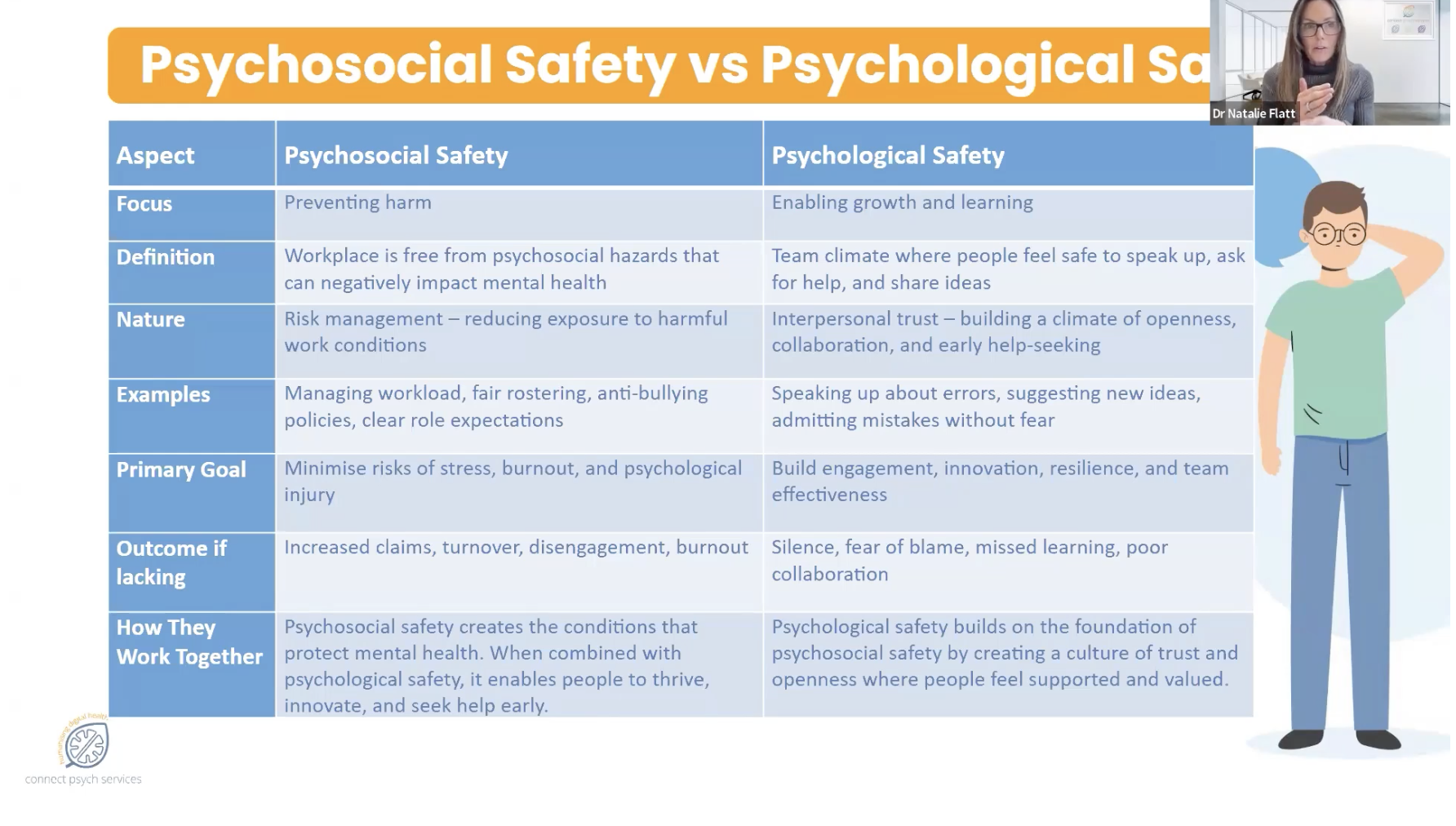
Psychosocial safety is about preventing harm in the first place, identifying and managing the workplace risk factors that can damage mental health: excessive workload, poor role clarity, weak managerial support, bullying, intrusive surveillance. This is risk reduction.
Psychological safety is about creating a climate of trust and openness, where people feel safe to speak up, share ideas, admit mistakes and ask for help without fear of judgement or retaliation. This is what enables growth.
The two are connected, not interchangeable. When people feel psychologically safe, they raise concerns before those concerns become psychosocial hazards. Without it, the same risk sits hidden until it surfaces as a claim.
A regulated leader, a regulated room
Natalie borrows a concept straight from neuroscience: when a leader hits a stress response, the amygdala fires and blood flow shifts away from the prefrontal cortex, the part responsible for planning, problem-solving and self-regulation. Mirror neuron research shows teams unconsciously catch this. A calm, regulated leader steadies a team through uncertainty; a dysregulated one spreads anxiety, whether they mean to or not.
That's why self-awareness comes first: understanding your own signs of stress before trying to read anyone else's.
Three traits show up consistently in leaders who get this right:
Curious — ask questions, then actually listen.Humble — willing to say "I don't have all the answers."
Consistent — showing up the same way, day after day.
Key takeaways from the session
1. Psychosocial safety and psychological safety solve different problems
One reduces risk (the hazards themselves). The other enables growth (the trust to raise them early). Workplaces need both, not one dressed up as the other.
2. A written policy isn't a lived culture
Staff notice the gap between what's stated and what's practised almost immediately. Natalie calls this cognitive dissonance, and it erodes trust faster than almost anything else. Psychological safety has to be measured (regular pulse checks, named explicitly in risk registers) and acted on, not just documented.
3. Leaders are the cultural architects, not the fixers
Leaders don't need to be psychologists. What matters is genuine care, emotional self-awareness, and consistency, showing up the same way over time. Their job is to listen without judgement and guide people to the right support, not solve the problem themselves.
4. Perception predicts distress as much as the hazard itself
Even if a leader believes the environment is safe, if employees perceive risk or fear speaking up, their brains respond as if it's unsafe. Culture and climate data — tracked over months, not as a one-off snapshot — is what closes that gap between leadership assumption and lived employee experience.
Speaker

Dr. Natalie Flatt
Phd, Psychologist and Co-Founder of Connect Psych Services
Dr Natalie Flatt, PhD, is a psychologist and Co-Founder of Connect Psych Services. With over 20 years of experience, she helps organizations build mentally healthy workplaces by translating psychological research into practical strategies. She specializes in partnering with leaders to develop emotionally intelligent, psychologically safe teams.

ecoPortal Webinars
Learn the latest and greatest health and safety strategies from global industry leaders.

Our Partners
We partner with a range of innovative health and safety organisations to bring you expert insights into the most pressing topics concerning health and safety today
All webinars
