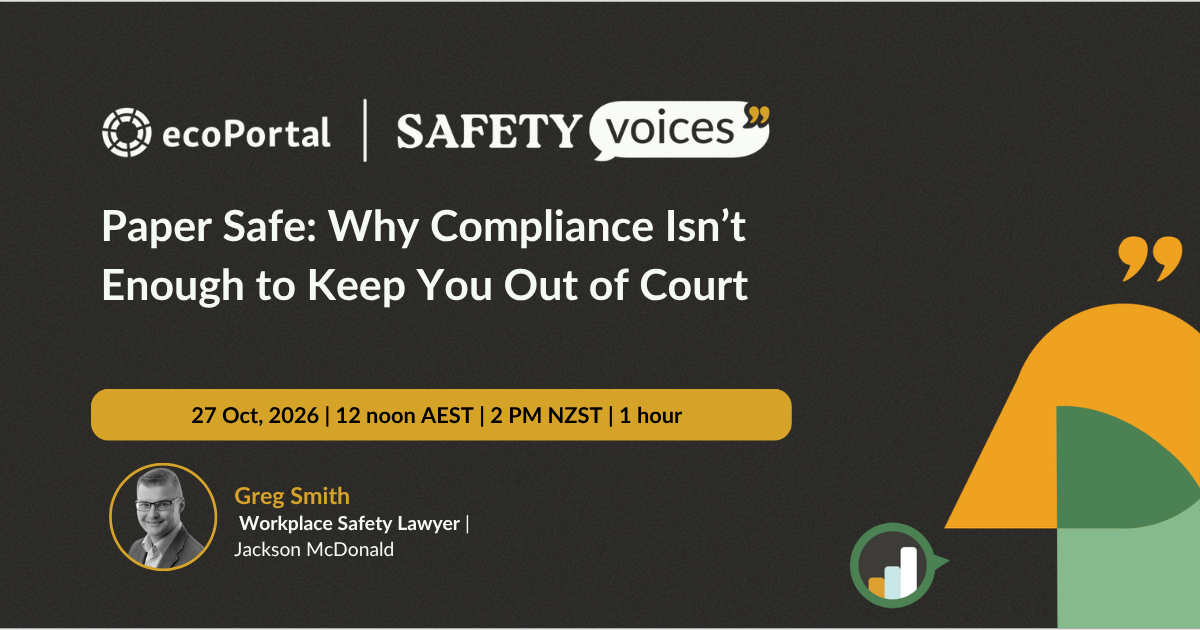

Paper Safe: Why Compliance Isn’t Enough to Keep You Out of Court

Greg Smith
Workplace Safety Lawyer | Jackson McDonald
Understand what’s critical from a safety perspective, pay attention to that, and do safety activities with the intention of understanding the efficacy of our systems.
- Greg Smith
About this session
A safety dashboard full of green lights feels like assurance. Policies written, inspections ticked, training at 98%. But in a courtroom, that green light carries very little weight, and the gap between what’s written down and what actually happens on site is exactly where a prosecution starts looking.
In this session of the Safety Voices webinar series, host Craig Bleakley sits down with Greg Smith, back after one of the top-rated sessions at ePIC 2026, to ask a question that deserves a straight answer: when a worker is harmed, was anyone safer because the form was filled?
Drawing on 35 years and more than 100 fatality cases, Greg unpacks why organisations keep mistaking documentation for protection, what courts and regulators actually look at, and how leaders can check that their systems work, not just that they exist.
Written, imagined, done
Safety research talks about the difference between work as imagined and work as done. Greg adds a third layer, because in a legal context most prosecutions begin with the documented process.
- Work as written: The policies, procedures and safe work method statements on file. This is where the regulator starts, and it sets the standard the organisation will be measured against.
- Work as imagined: What leaders believe is happening on the ground, often based on dashboards, completion rates and the absence of incidents.
- Work as done: How the task is actually performed, on a real shift, under real conditions.
The rule for assurance: every document needs evidence that it reflects what was really going on. Training records are useful, but only if workers are doing the job the way they were trained to do it.
Proper, implemented, effective
Greg’s shorthand for what any leader should want to know comes down to three questions, asked about every critical risk in the business.
- Proper: Do we have a system to manage this risk? This is the straightforward part. Technical expert evidence can confirm whether your working at heights system meets the codes of practice and regulations.
- Implemented: Is that system actually in place on site, understood by the people using it, and normally complied with?
- Effective: Is it working? Not “have we done the right number of checks”, but what those checks revealed and how confident we are that the control holds.
Key takeaways from the session:
1. Know what a document is for, then test it
If you can’t name the purpose of a take five or a pre-start checklist, you can’t test whether it’s working. The test itself is simple: stand next to a worker, look at their completed form and ask them to talk you through the hazards on the job. If what they say doesn’t match what’s on the card, the paperwork isn’t doing its job.
2. Report what was looked at, not how many times
A count of completed observations tells a board very little. One organisation Greg worked with found that fewer than 4% of 2,800 inspections had looked at confined space entry, one of its critical risks, while most focused on housekeeping and PPE. Adding a few lines of analysis under the dashboard turns a number into something leaders can act on.
3. Culture enables safety, but it isn’t evidence of it
Trust, visible leadership and a strong culture make it easier for people to speak up and stop the job. But a culture survey score doesn’t show that a risk was controlled, the right equipment was used or the job wasn’t rushed. Connecting that care to tested systems is what makes it count.
4. Data nobody reads can still be used
Technology cuts both ways. In-cab footage that was never reviewed, or a 15-page safe work method statement signed in an average of 4.2 seconds, can become the regulator’s best evidence. Used well, AI can help analyse thousands of records quickly, as long as the organisation knows what questions it wants answered.
Speaker
Greg Smith
Workplace Safety Lawyer | Jackson McDonald
Greg Smith is a leading workplace lawyer, advising some of Australia's largest employers on compliance, incident investigation and response, and safety management. He's appeared in the Supreme Court, District Court, and Magistrates Court of Western Australia, the Federal Court, and the State Administrative Tribunal, and has been involved in military boards of inquiry into major accidents.
Greg also designs and delivers training on management responsibilities and contractor safety, and developed and taught the accident prevention unit at Curtin University's School of Public Health, Health, Safety and Environment. He's the author of Paper Safe.
Watch our webinars
Learn the latest and greatest health and safety strategies from global industry leaders.
Our Partners
We partner with a range of innovative health and safety organisations to bring you expert insights into the most pressing topics concerning health and safety today