
.png)
.jpg)
.jpg)
.png)
%20(1).jpg)
Critical Risks: What's Really at Stake in Your Industry?
.jpg?width=400&height=400&name=unnamed%20(1).jpg)
Every industry has critical risks, and we really need to start looking at critical risk with different strategies because there are different root causes associated with it.
- Nada Wentzel
About this session
"Critical risk" has long been a term associated with high-hazard, industrial workplaces, where a serious incident is immediate and impossible to miss. But every industry carries risks of similar severity, they just don't always come with a hard hat.
In this session of the Safety Voices webinar series, host Craig Bleakley sat down with Nada Wentzel, CEO of The Jonah Group, to unpack what critical risk really means once you move beyond physical hazards.
Drawing on more than 30 years working across high-consequence industries including oil, gas, mining and aviation, Nada explains how human decision-making under pressure drives incidents in every sector, and introduced the concept of "limbic risk", the science behind why our brains default to autopilot when stress takes over.
The OWL Storytelling Framework
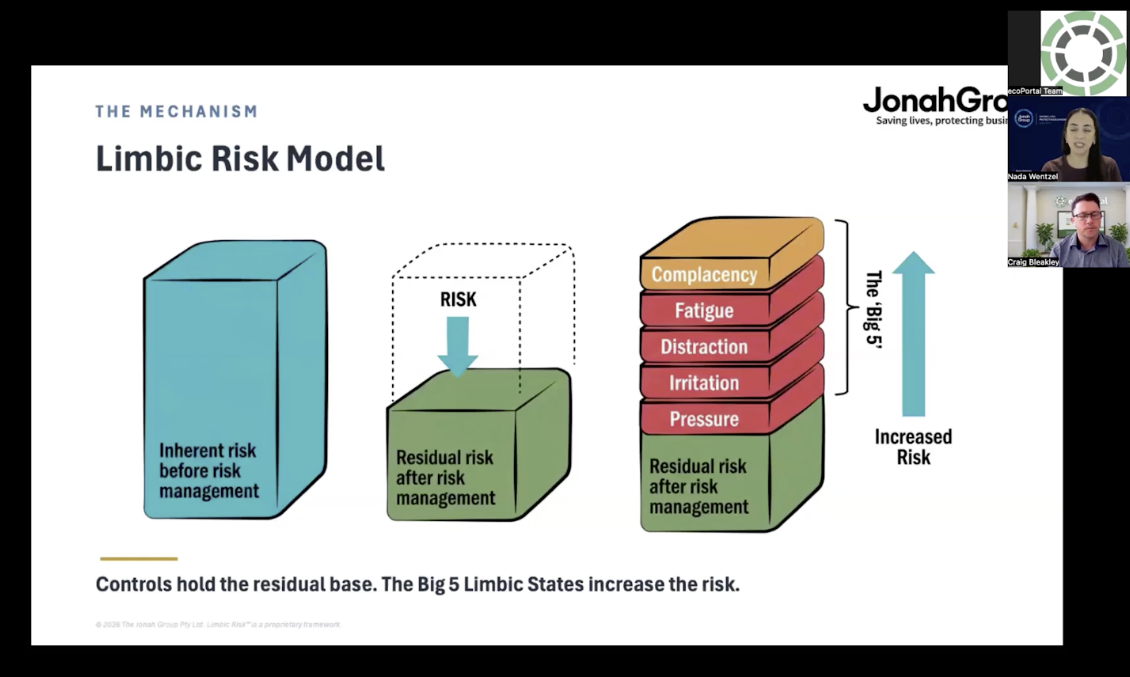
Two parts of the brain govern decisions under pressure: the limbic system, responsible for fast, automatic responses, and the prefrontal cortex, the logical brain behind rational, considered decisions. Under stress, the limbic system acts like a boom gate, controlling access to that logical brain.
Traditional risk management stops at residual risk: inherent risk, minus whatever controls are in place. Nada adds a third layer. Put a stressed person into that equation, and one or more of five states tend to show up, pushing the risk back up:
- Pressure, which triggers survival mode
- Irritation, with the system, process or people involved
- Distraction, from noise, poor procedures or lack of clarity
- Fatigue Complacency, which isn't an attitude problem. It's what the brain defaults to when doing the same task day in, day out, looking for shortcuts
When one or more of these states is present, the brain defaults to inattention, which shows up in predictable ways: rushing, mistakes, poor decisions built on assumption, risk blindness, procedural creep, "tick and flick" behaviour, and poor communication.
Key takeaways from the session
1. Frequency isn't severity
Many organisations track high-frequency, low-consequence incidents like slips and minor injuries, but these rarely share root causes with the incidents that result in fatalities. Critical risk needs its own strategy, separate from general incident reporting.
2. People, systems and assets: the interdependency
Nada frames critical risk management as a triangle: systems and processes, physical assets and environment, and people, who are the last line of defence.
Referencing James Reason's Swiss cheese model, she explains that over-relying on any single element is what sets organisations up for failure.
3. Verification is the missing piece
Most organisations have started identifying critical risks and building registers. The real gap is whether controls are actually field-verified rather than just reported as complete. By the time information reaches boards and senior leaders, it's usually smoothed into a summary, with the inconvenient detail filtered out.
Direct visibility into live safety data, rather than a paragraph in a monthly report, is what lets leadership actually fulfil their due diligence.
Speaker
.jpg)
Nada Wentzel
CEO | The Jonah Group
Nada Wentzel advises boards and senior leaders on managing critical risk in high-consequence environments. With 30+ years across oil, gas, mining, and energy, she helps organisations move beyond compliance, building stronger leadership, better decision-making, and cultures where risk is understood, owned, and acted on.
Watch our webinars
Learn the latest and greatest health and safety strategies from global industry leaders.

Our Partners
We partner with a range of innovative health and safety organisations to bring you expert insights into the most pressing topics concerning health and safety today
All webinars

.png?width=352&name=Workplace%20Fatalities%20Understanding%20the%20Family%20Impact%20and%20Communicating%20Better%20(1).png)