



Retail Crime: The Health and Safety Crisis in Customer-Facing Environments

“Eight years ago, our biggest risk in terms of crime was robbery. You fast forward through to today, and our main risk is customer aggression. That's what we live and breathe.”
— Lisa White
About this session
Retail crime is now reported to cost the industry $7.79 billion in Australia and $2.6 billion in New Zealand annually, and businesses are feeling the strain. Criminal acts ranging from physical assaults to psychological trauma are creating an emerging health and safety crisis in customer-facing environments.
Robbery used to be the risk Bank of New Zealand (BNZ) trained for. Now the bank is close to seven years without one, and Lisa White, BNZ's Head of Protective Services, spends her time on customer aggression instead. She says the banking industry has seen an increase of more than 300% since COVID.
In this ecoPortal webinar, host Craig Bleakley sat down with Lisa to look at how BNZ responds: rating every incident, giving frontline staff clear authority to disengage, and designing branches and training around behaviour. She also covers the psychological side of the job, from immediate debriefs to counselling for the teams who deal with the worst of it.
Whether you run a bank branch, a retail floor or a customer service desk, the question is the same: what do your people do in the moment it turns, and who looks after them after?
How BNZ rates aggression, from frustration to assault
BNZ records every incident and rates it on a seven-level scale, from verbal abuse at level 2 to serious physical assault at level 7. Lisa walked through it on screen.
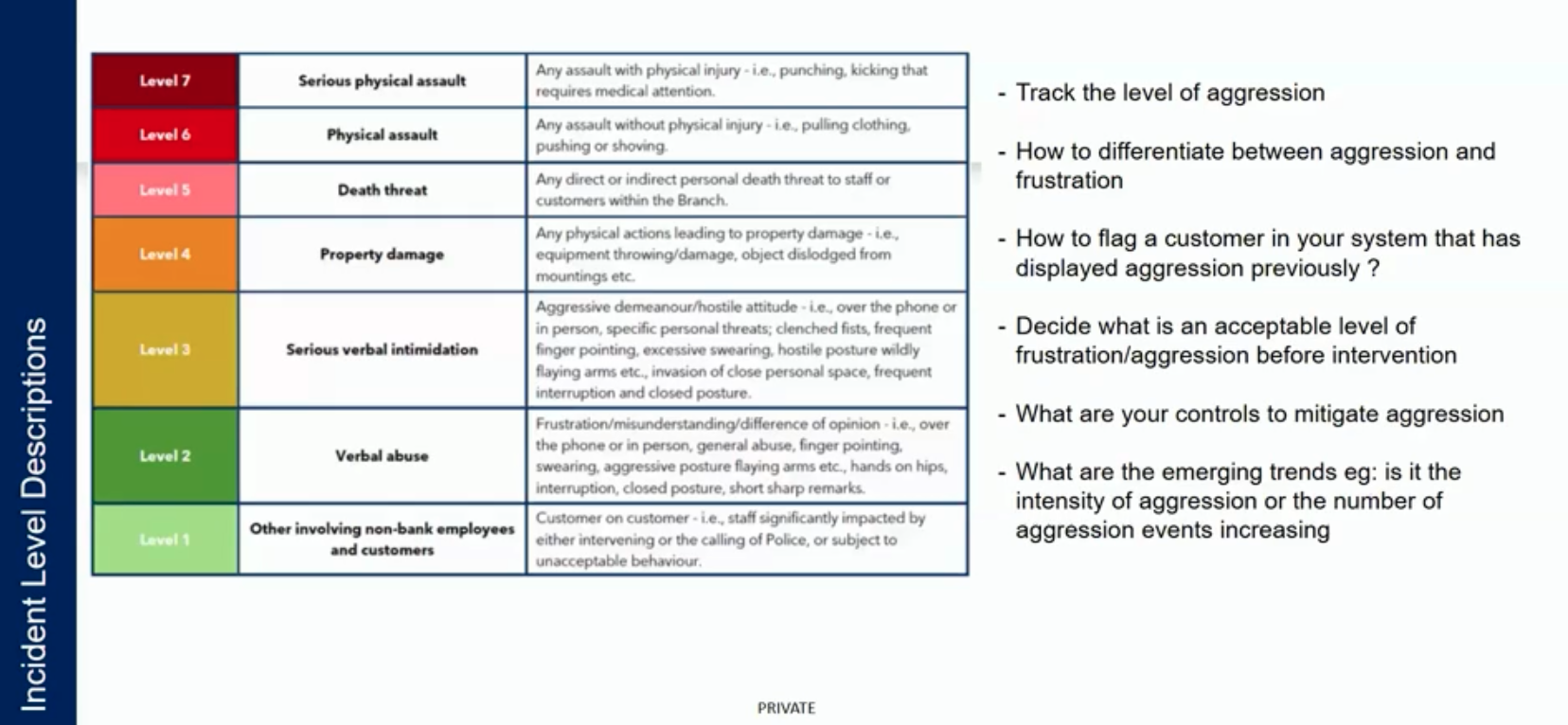
BNZ's incident level descriptions, as shown by Lisa White in the session.
How this works in practice:
- Most incidents sit at levels 2 and 3, where frustration is turning into aggression. Above that, BNZ can trespass or exit the customer.
- Outcomes follow a behaviour-based matrix, regardless of age, race, sex or wealth. A first incident brings a call, a written warning and a flag on the account. A repeat brings contact from the security team and a decision on trespass or exit.
- A weekly meeting reviews at least three exits with the vulnerability, collections and branch leadership teams. Sometimes the answer is a set of conditions, such as phone-only contact.
- Death threats are assessed for credibility, looking at capability and intent. A credible threat means calling 111.
The slide also poses five questions for any organisation:
- Are you tracking the level of aggression?
- How do your people tell aggression from frustration?
- How do you flag a customer who has been aggressive before?
- What level of frustration or aggression is acceptable before you step in?
- Are incidents getting more intense, or just more frequent?
When it escalates: the 4 Ds and the safe haven
Every BNZ frontline employee gets the same training, whether they work in central Auckland or a small rural branch.
It starts with CLEAR for frustrated customers: control, listen, empathise, acknowledge, resolve. Lisa's test for when it has moved beyond frustration is how the customer makes you feel. Scared, nervous or anxious means aggression.
The 4 Ds:
- Detect: make sure everyone in the branch knows. Use a firm voice and two commands: what you want them to stop, and what happens if they don't.
- Distance: take two steps back.
- Disengage: walk swiftly, don't run, to the safe haven. Everyone moves or no one does.
- Debrief: straight away, with the branch closed for five to ten minutes if needed.
A safe haven is anywhere the aggressor can't follow, including a public space out the front of the branch. Staff are trained to move there together, without waiting for approval, and to treat every move as necessary regardless of how the incident is judged afterwards.
Key takeaways from the session
1. Customer aggression has replaced robbery as the main risk.
A robbery response is to comply. An aggression response is to set firm limits. Controls built for one won't work for the other.
2. A shared scale shows the trend.
Rating every incident the same way lets you see whether aggression is getting more intense or just more frequent, and keeps outcomes fair.
3. Give staff authority to disengage, and a place to go.
Employees can close a branch or leave without approval. A safe haven can be a locked room or a busy public space, and a counter or bench buys distance while you get there.
4. Psychological harm counts without physical contact.
Contact centre staff take a micropause after abusive calls, and security and vulnerability teams get monthly counselling alongside EAP support.
Speaker

Lisa White
Head of Protective Services | Bank of New Zealand
Lisa White brings over 15 years of leadership experience in people and safety management across various high-risk sectors, including banking. She’s a passionate advocate for creating safe, inclusive, and supportive work environments. With a strong background in developing safety systems, driving cultural transformation, and leading employee wellbeing initiatives, Lisa excels in tackling the complex challenges of health, safety, and mental health in the workplace. Her focus on proactive safety measures, employee engagement, and long-term wellbeing makes her a leader in workplace safety innovation.
ecoPortal past webinars
Learn the latest and greatest health and safety strategies from global industry leaders.

Our Partners
We partner with a range of innovative health and safety organisations to bring you expert insights into the most pressing topics concerning health and safety today
All webinars