
.png)
.jpg)
.jpg)
.png)
%20(1).jpg)
.png?width=352&name=SS6%20Designing%20for%20Error%20(1).png)

AI-Powered Risk Intelligence: Smarter Insights, Safer Workplaces
Presentation Slides
It's your friend. It's your helper, but [AI] is not your superior.
- Liz Hancock
About this session
A tender document that would normally take three days took three hours. A CCTV system flagged an ergonomic risk safety teams had missed entirely, and incidents dropped by sixty five percent once it was fixed. AI isn't replacing the safety professional's job. It's clearing the tedious eighty percent of it so there's more time left for the twenty percent that actually needs a person.
In this session of the Safety Voices webinar series, host Craig Bleakley sits down with Liz Hancock to map out where AI genuinely earns its place in a health and safety function, where it quietly falls short, and why the line between the two isn't about the technology at all. It's about what still needs a human on the shop floor.
Where it's safe to use AI in safety
Liz is direct about where the technology earns its keep.
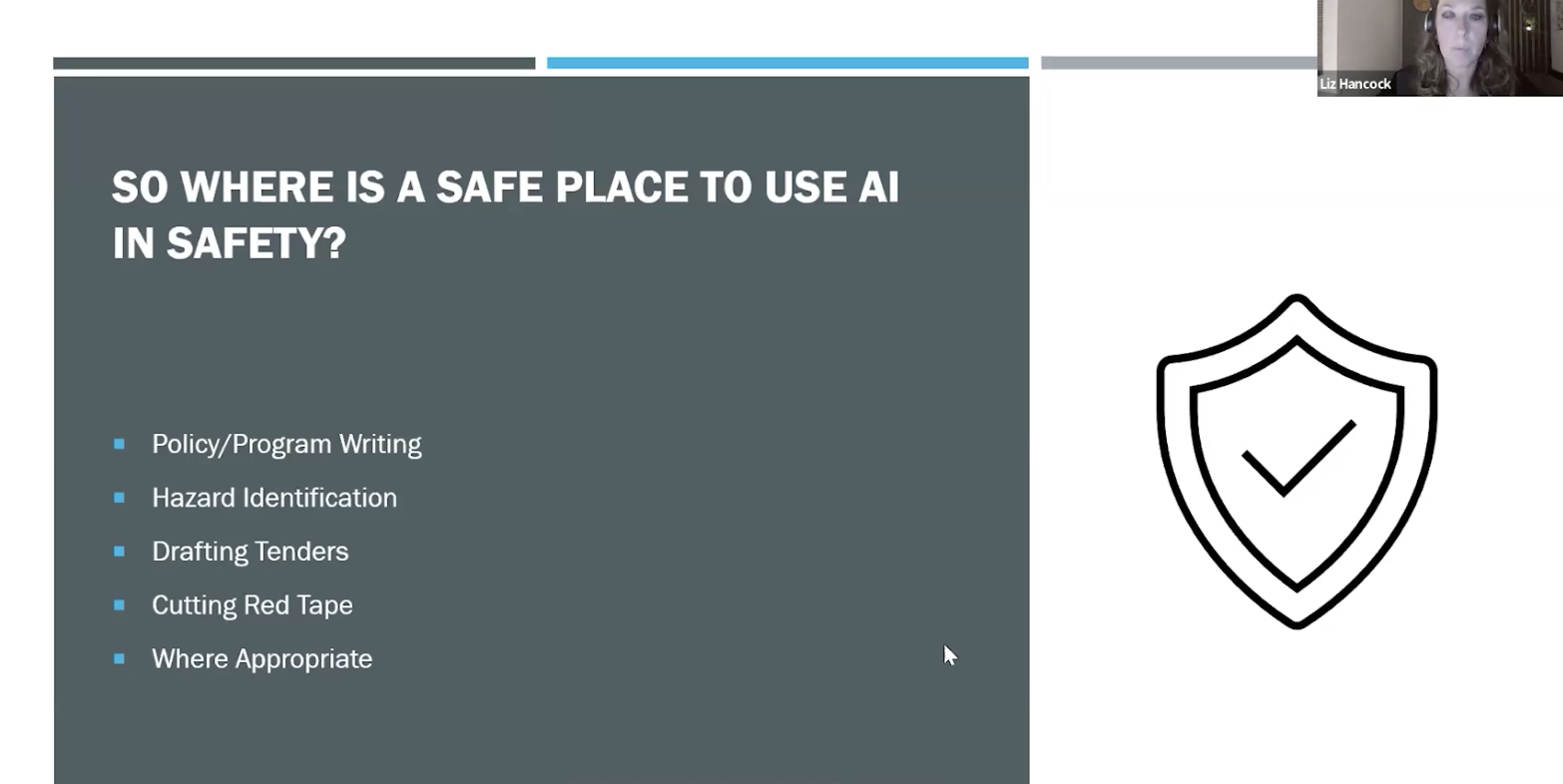
- Policy/program writing — turning a multi-day drafting job into a few hours of review and personalisation.
- Hazard identification — spotting risks in a photo or video of a workspace, then suggesting controls to design them out.
- Drafting tenders — pulling together detailed, industry-specific documentation from a clear brief.
- Cutting red tape — helping operational teams own their own hazard identification and controls, rather than routing everything through a safety advisor.
- Where appropriate — the caveat that runs under everything else on the list.
The seventy percent rule
Liz returns to one number throughout the session: AI will get you seventy, maybe eighty percent of the way there. Never further.
It's fast at hazard identification, drafting policies, writing tenders, generating board reports, and spotting trends across years of incident data that a person would never have time to cross-reference by hand. But it also confidently flagged a shiny floor as a spill and a bookshelf as an unauthorised ladder in the same afternoon. It doesn't install the guard rail, mount the signage, or have the honest conversation with a colleague about why they're not following a safe system of work. It's not a source of truth. It's a first draft.
The practical takeaway isn't caution for its own sake. It's knowing exactly which seventy percent to hand over, and which thirty percent stays firmly with a person.
Key takeaways from the session:
1. The best use cases are the ones nobody notices
Drafting policies, writing tenders, building board reports, reviewing existing procedures for what's out of date. None of it is glamorous, but it's the work that used to eat entire days, and giving it back is what actually frees up a safety professional's time for the floor.
2. Consultation is what turns AI from surveillance into trust
Rolling out AI-powered CCTV without involving worker reps, unions or legal first reads as spying. Rolling it out as a project, with blurred faces, a clear "this isn't for discipline" commitment and worker input from day one, turns the same technology into something the workforce actively champions.
3. Never let AI touch the moment itself
Emergency response planning is a strong use case. Responding to an emergency in progress is not. The plan needs to already exist and already be known before anything happens; that's not a moment to start prompting a chat function.
4. Gut still wins
When AI-generated insight conflicts with frontline experience, Liz goes with the person on the shop floor every time. No output replaces the conversation of actually asking someone whether the safe system of work is being followed, or why not.
Speaker
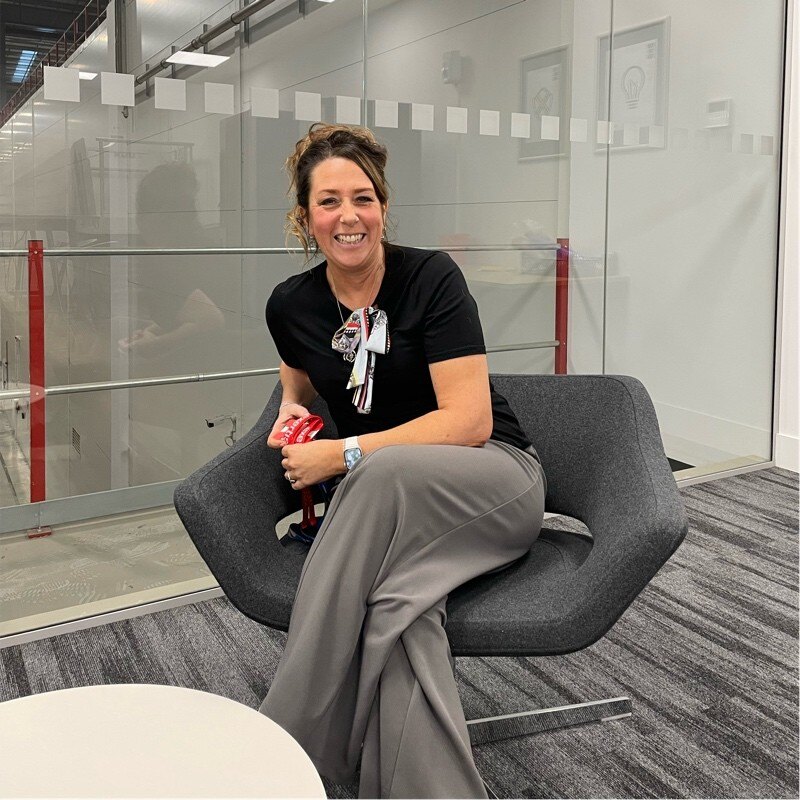
Liz Hancock
Director of HSE, DCC Technology
With 22 years of experience across health, safety, and environmental fields—including enforcement, insurance, consultancy, and strategic leadership—Liz brings deep expertise to the industry. She holds a degree in Health, Safety, and Environmental Management and is a Chartered Fellow of the Institute of Occupational Safety and Health (IOSH).
Liz has worked across diverse sectors, including manufacturing, warehousing, and distribution, and has gained international experience in Europe, North America, and Australia.
ecoPortal past webinars
Learn the latest and greatest health and safety strategies from global industry leaders.

Our Partners
We partner with a range of innovative health and safety organisations to bring you expert insights into the most pressing topics concerning health and safety today.
All webinars

.jpg?width=352&name=_From%20Unsafe%20to%20Engaged%20Leading%20Safety%20on%20the%20Retail%20Frontline%20(2).jpg)